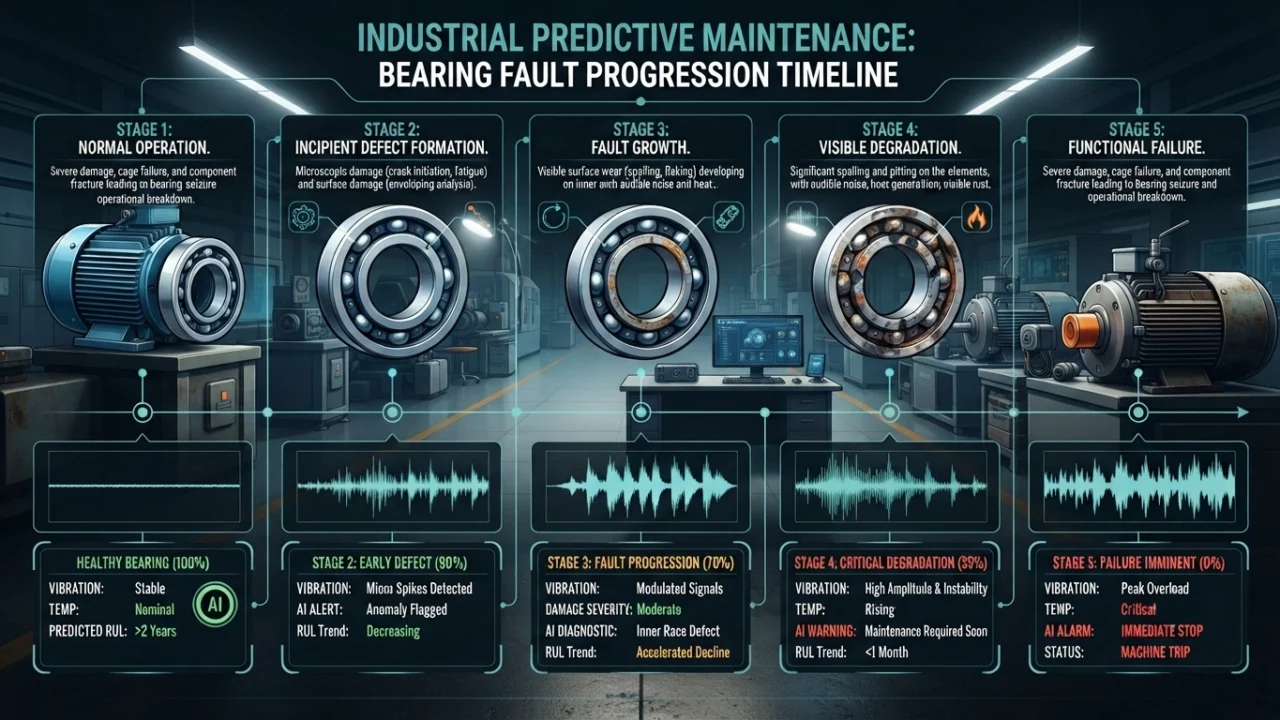
Bearing Fault Progression: 5 Stages Every Reliability Team Should Know
In This Guide
In this guide, we’ll cover:
- Why bearing failures are one of the most common industrial reliability challenges
- The five stages of bearing fault progression
- How vibration analysis detects defects before failure occurs
- Why traditional monitoring often catches faults too late
- How AI improves bearing fault diagnosis
- The true cost of bearing failures
- Frequently asked questions about bearing condition monitoring
This article is part of our Predictive Maintenance Ultimate Guide, which covers the P-F Curve, core condition monitoring technologies, and the broader business case for predictive maintenance in more depth.
Bearings Rarely Fail Overnight: The Real Bearing Fault Progression
Walk through any industrial facility after an unexpected equipment shutdown and you’ll often hear a familiar explanation: ‘The bearing just failed.’
In reality, that explanation skips over the real story — the bearing fault progression that had already been developing for weeks, months, or sometimes even longer, the same pattern we explore across all rotating equipment failures in why equipment failures rarely happen overnight.
Long before a bearing seizes, overheats, or causes a machine to stop, it begins producing subtle warning signs — signs that condition monitoring technologies, particularly vibration analysis, can detect.
The challenge is not whether those warning signs exist. The challenge is recognizing them early enough to act.
In fact, understanding how bearing faults progress is one of the most valuable concepts in predictive maintenance, because it reveals where the greatest opportunities for intervention — and cost savings — exist.
Why Bearings Matter More Than Most Teams Realize
Bearings are among the most critical components in rotating equipment. Motors, pumps, fans, compressors, gearboxes, conveyors, and countless other industrial assets rely on them to support rotating shafts while minimizing friction.
When a bearing fails, the consequences often extend far beyond the bearing itself. A deteriorating bearing can lead to increased vibration, shaft damage, seal failures, lubrication contamination, increased energy consumption, secondary equipment damage, and unplanned production downtime.
Because bearings exist in virtually every rotating asset, they represent one of the most common sources of machine failure across industries including steel, cement, mining, oil & gas, and food & beverage manufacturing.
According to research summarized in peer-reviewed engineering literature, bearing defects are responsible for approximately 41% of induction motor failures — making bearings one of the single most heavily monitored fault categories in predictive maintenance programs worldwide
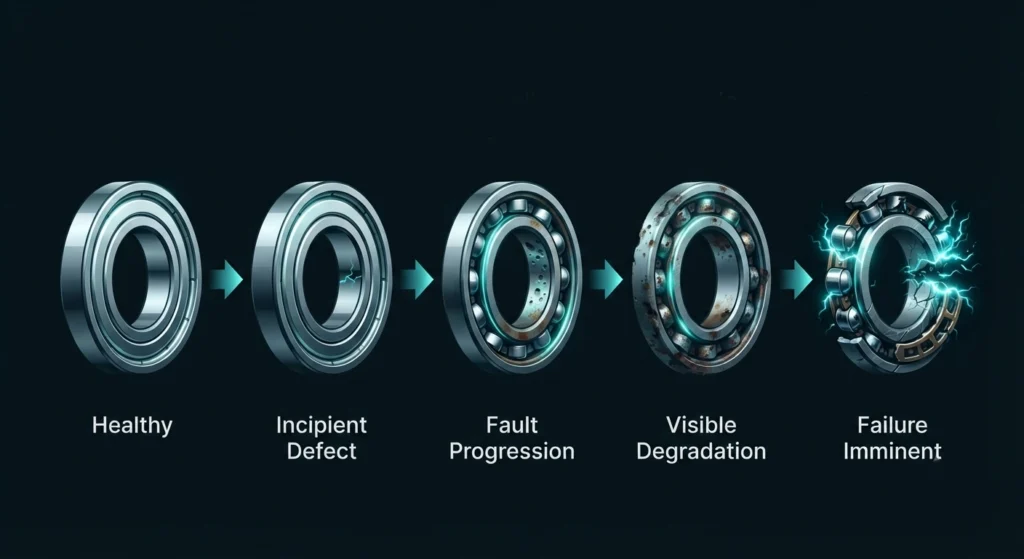
The Five Stages of Bearing Fault Progression
Bearing failure is not a single event. It is a bearing fault progression — a process that helps maintenance teams identify where intervention creates the greatest value.
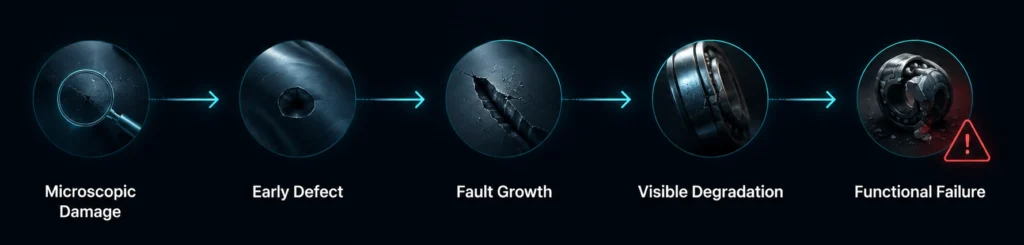
| Stage | Description |
| Stage 1 | Microscopic Damage |
| Stage 2 | Early Defect Formation |
| Stage 3 | Fault Growth |
| Stage 4 | Visible Degradation |
| Stage 5 | Functional Failure |
Stage 1: Microscopic Damage Begins
Every bearing starts its failure journey at a microscopic level. Material fatigue, inadequate lubrication, contamination, improper installation, excessive loading, or manufacturing imperfections begin creating tiny defects on bearing surfaces.
At this stage, no visible damage exists, no audible noise is present, temperature remains normal, and machine performance appears unchanged. Operators and maintenance technicians typically have no way of identifying the problem through routine inspection. However, subtle high-frequency vibration changes may already be present — often the first indication that deterioration has begun.
Stage 2: Early Defect Formation
As damage progresses, localized defects begin forming on one or more bearing components — the outer race, inner race, rolling elements, or cage assembly. The bearing continues functioning normally, but repeated impacts occur whenever rolling elements pass over the damaged area, generating characteristic vibration signatures associated with specific defect locations.
At this stage, temperature often remains normal, noise is usually undetectable, production remains unaffected, and visual inspections rarely identify the problem. Yet vibration analysis can frequently detect the fault.
This is often where the greatest maintenance value exists. The fault is detectable, but corrective action is still relatively inexpensive and easy to schedule.
Most organizations never detect bearing faults during Stage 1. The greatest reliability advantage comes from detecting faults during Stage 2, when intervention can still be planned and scheduled with minimal operational disruption.
Stage 3: Fault Growth
As the defect expands, the bearing generates stronger and more consistent vibration patterns. The damage becomes easier to identify through frequency analysis, and fault-specific signatures begin standing out more clearly from normal operating behavior.
Maintenance teams may begin observing increased vibration amplitudes, more frequent fault-related frequencies, emerging sideband patterns, and accelerated deterioration trends. The bearing is still operational, but the failure process is no longer subtle. At this point, the maintenance planning window remains open — but it is beginning to narrow.
Stage 4: Visible Degradation
Eventually, bearing damage becomes severe enough to create symptoms that extend beyond vibration data. The machine may begin exhibiting elevated temperatures, audible noise, increased friction, lubrication contamination, and reduced operating efficiency.
Many organizations first become aware of a bearing problem at this stage. Unfortunately, by the time symptoms become visible to operators, the fault has often progressed significantly along the P-F Curve. Corrective actions are still possible, but maintenance costs and operational risks are increasing rapidly.
Stage 5: Functional Failure
This is the stage most teams refer to as “the failure.” The bearing can no longer perform its intended function. Potential outcomes include bearing seizure, catastrophic internal damage, shaft damage, coupling damage, motor overload, or complete equipment shutdown.
At this stage, the maintenance conversation shifts from prevention to recovery. The opportunity for low-cost intervention has already passed.
A Typical Bearing Fault Progression Timeline
| Stage | What Happens | Detectable by Vibration? | Visible to Operators? |
| Microscopic Damage | Crack initiation, early wear | Yes | No |
| Early Defect Formation | Localized bearing damage | Yes | No |
| Fault Growth | Expanding defect | Yes | Rarely |
| Visible Degradation | Heat, noise, contamination | Yes | Yes |
| Functional Failure | Equipment can no longer operate normally | Yes | Definitely |
This timeline illustrates the full bearing fault progression and shows why vibration analysis is so valuable: it identifies problems long before they become obvious through traditional inspections. It maps directly onto the P-F Curve concept covered in our Predictive Maintenance Ultimate Guide — the earlier a fault is caught on this curve, the more options a maintenance team has.
Why Traditional Monitoring Misses Early Bearing Fault Progression
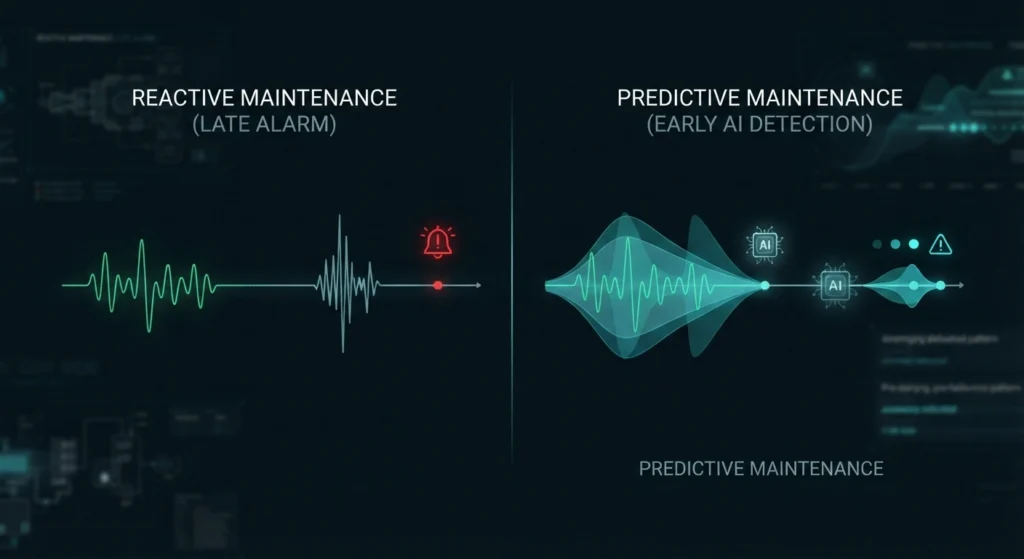
Many monitoring systems rely heavily on alarm thresholds: if vibration exceeds a predefined limit, generate an alarm. These thresholds are often set using general vibration severity standards such as ISO 20816 (the international standard for evaluating machine vibration via measurements on non-rotating parts), which is useful for flagging overall severity but was never designed to diagnose specific, early-stage fault types. While this approach works for severe faults, it often struggles with early-stage bearing defects. A developing bearing fault may create identifiable patterns weeks before overall vibration levels exceed alarm thresholds.
As a result, maintenance teams can find themselves in a reactive situation despite having monitoring systems installed. The issue isn’t a lack of data. It’s a lack of interpretation. By the time a threshold-only system generates an alarm, the fault may already be well into its progression curve.
How Vibration Analysis Tracks Bearing Fault Progression Early
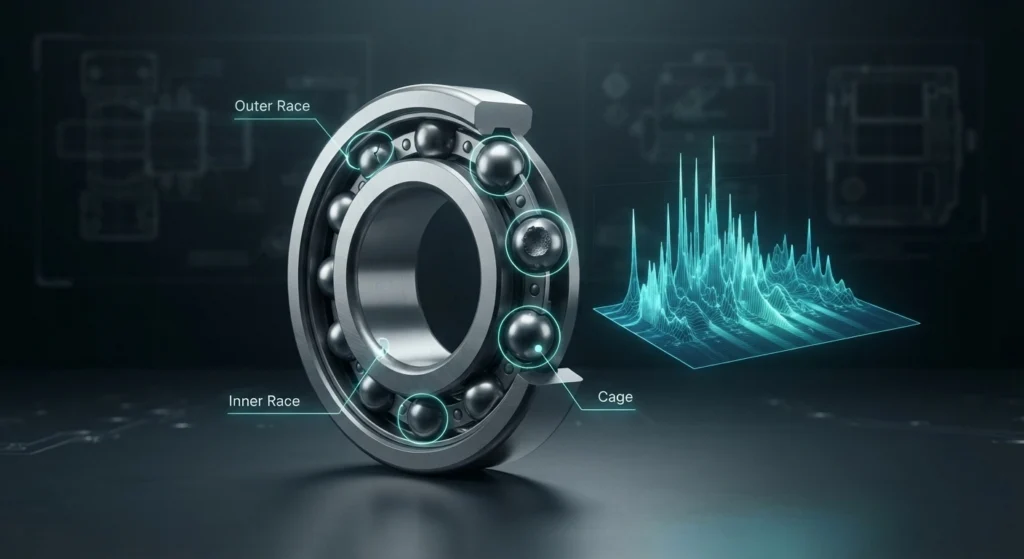
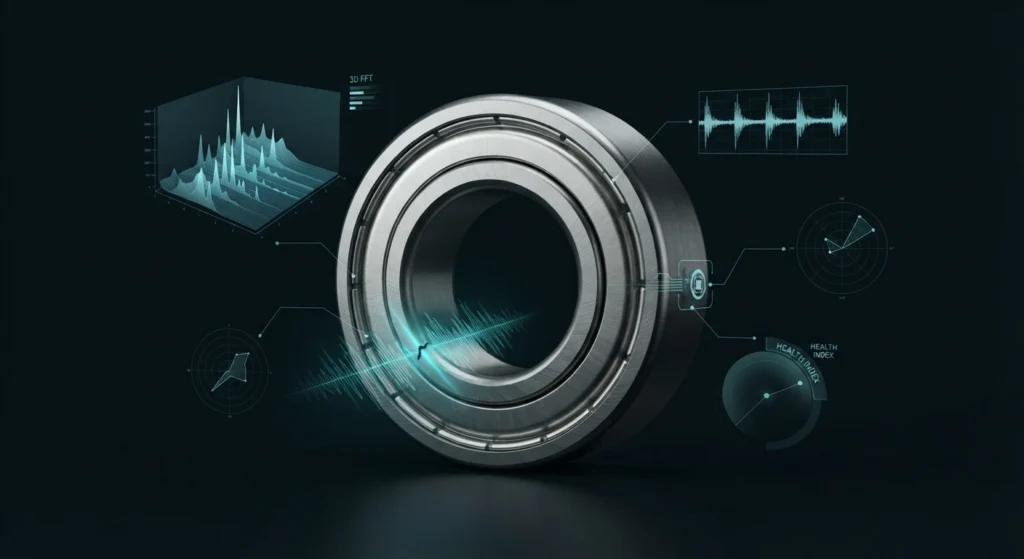
Bearings produce characteristic frequencies that correspond to specific components and defect locations. Experienced analysts often look for patterns associated with BPFO (Ball Pass Frequency Outer Race), BPFI (Ball Pass Frequency Inner Race), BSF (Ball Spin Frequency), and FTF (Fundamental Train Frequency).
BPFO → Outer race defect
BPFI → Inner race defect
BSF → Rolling element defect
FTF → Cage defect
These frequencies help identify not only the presence of a fault, but also where the fault is developing within the bearing.
The goal is not simply to determine that vibration has increased. The goal is to determine why it has increased. This distinction is what transforms monitoring into diagnosis — a theme we explore further in how AI interprets vibration data.
Where AI Changes the Bearing Fault Progression Equation
Modern industrial facilities generate enormous volumes of vibration data. A single facility may monitor hundreds of rotating assets, each generating continuous condition information. Reviewing every signal manually is difficult. Reviewing every signal consistently is even harder.
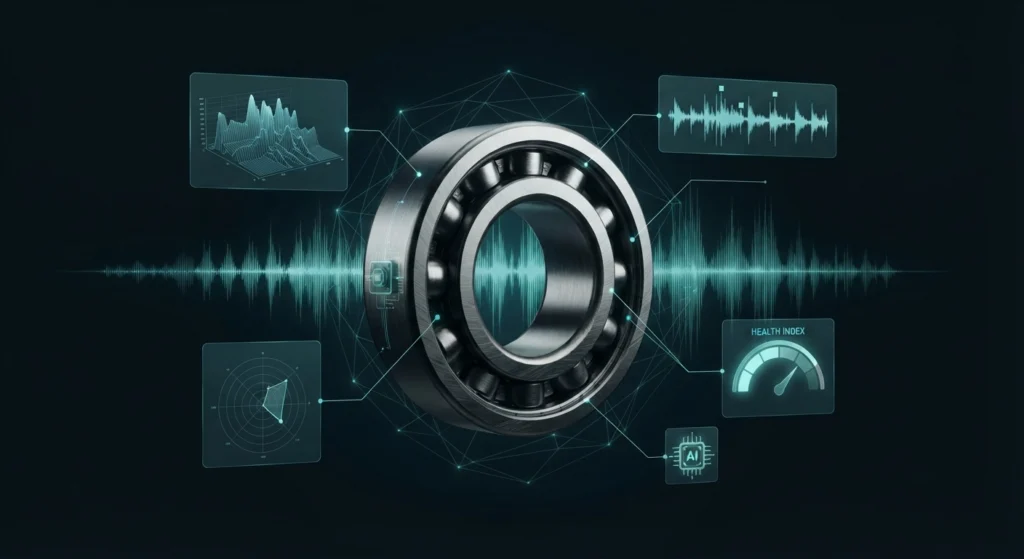
This is where AI-powered vibration interpretation creates value. Rather than relying solely on threshold alarms, machine learning models can continuously evaluate vibration patterns and compare them against known fault signatures.
Synapse Edge Reliability Intelligence
Synapse Edge has been trained on more than 1 million real industrial vibration data points and can identify 17+ common machine fault types across industries including steel, cement, mining, oil & gas, and food & beverage.
Instead of simply reporting abnormal vibration levels, the platform helps maintenance teams understand the likely fault mechanism behind those signals.
In practical terms, AI helps shift the conversation from “something looks unusual” to “this pattern resembles an early-stage outer-race bearing defect.” That difference can translate into weeks of additional planning time.
The Real Cost of an Unmanaged Bearing Fault Progression
A bearing itself is often inexpensive. The failure it causes is not.
A failed bearing may cost only a few hundred dollars to replace, but the resulting production interruption can cost thousands or even tens of thousands of dollars depending on the operation — once lost production, expedited parts, and overtime labor are factored in.
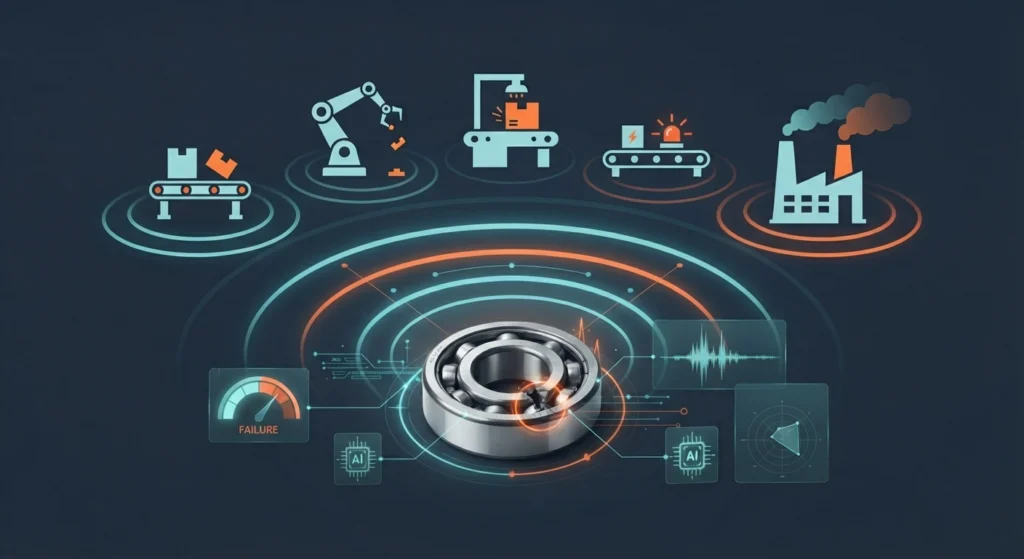
The true cost of a bearing failure may include lost production, emergency maintenance labor, overtime costs, secondary equipment damage, expedited spare parts procurement, delayed deliveries, and reduced operational efficiency. In many facilities, downtime costs far exceed the price of the failed component — sometimes by several orders of magnitude.
This is why reliability programs focus so heavily on early fault detection. The value is not in replacing bearings. The value is in avoiding the consequences of replacing them too late.
The Bigger Reliability Lesson from Bearing Fault Progression
The bearing fault progression offers a useful lesson about industrial reliability in general. Machines rarely move directly from healthy operation to catastrophic failure. Instead, faults develop gradually, producing warning signs throughout their progression.
Organizations that can identify those signals early gain something extremely valuable: time. That means time to investigate. It means time to plan. And it means time to schedule maintenance — ultimately, time to prevent downtime.
Conclusion: Understanding Bearing Fault Progression
Bearing failure is never really sudden — it’s a five-stage process that plays out over weeks or months, and the stage at which a fault is caught determines almost everything about the cost and disruption of fixing it.
The Five Stages, Summarized
In Stage 1, microscopic damage begins with no detectable symptoms. In Stage 2, early defects form on a specific bearing component and start producing characteristic vibration signatures, even though the machine still sounds and feels normal — this is the stage where intervention is cheapest and easiest to schedule.
By Stage 3, the fault has grown enough to stand out clearly in frequency analysis, and the planning window begins to narrow. In Stage 4, degradation becomes visible through heat, noise, or contamination, and the cost of intervention rises sharply. By Stage 5, the bearing has reached functional failure, and the conversation shifts from prevention to recovery.
Why Stage 2 Is the Real Opportunity
The single most important takeaway from this progression is that early detection is not a nice-to-have — it’s the difference between a scheduled, low-cost repair and an unplanned, expensive one. Most organizations never catch a bearing fault in Stage 1, simply because the signals are too subtle. But Stage 2, where defects are detectable through vibration analysis yet still invisible to the naked eye or a handheld thermometer, represents the greatest reliability opportunity available to any maintenance program.
How AI Closes the Gap
This is exactly the gap that AI-powered vibration monitoring is designed to close. Rather than waiting for a threshold alarm that typically fires closer to Stage 3 or 4, AI models trained on real fault signatures — including the specific frequency patterns tied to outer-race, inner-race, rolling-element, and cage defects — can flag a developing bearing problem while it’s still a Stage 2 issue, giving maintenance teams weeks of additional planning time instead of hours of emergency response.
The Bottom Line
Understanding this progression is one of the simplest, highest-leverage concepts in industrial reliability. The equipment is already telling you what’s happening. The only question is whether your monitoring approach is built to listen early enough.
Frequently Asked Questions
In many cases, vibration analysis can identify a bearing fault progression weeks or even months before failure occurs, depending on operating conditions, sensor placement, and monitoring frequency.
AI systems can often classify patterns associated with specific fault types, including outer-race defects, inner-race defects, rolling-element damage, and other common bearing failure modes.
Most bearing failures generate measurable changes before functional failure occurs. The challenge is detecting and interpreting those changes early enough to act.
Common causes include inadequate lubrication, contamination, improper installation, excessive loads, misalignment, imbalance, and normal material fatigue. Misalignment and imbalance in particular are frequently underdiagnosed root causes — see our article on unbalance vs misalignment for how to tell them apart in vibration data.
Temperature monitoring is valuable, but many bearing defects produce detectable vibration changes long before significant temperature increases occur.
Yes, to a large extent. Lubrication-related issues typically produce different vibration characteristics — often broadband, less structured signals — compared to the discrete, frequency-specific signatures of a developing mechanical defect like a race or rolling-element fault.
This depends on the criticality of the asset and the monitoring method. Continuously monitored critical assets can be evaluated in near real time, while less critical equipment is often checked on a periodic basis, such as weekly or monthly. The higher the criticality and the faster a fault could progress, the more frequent monitoring should be.
See How Synapse Edge Detects Bearing Defects Before They Become Failures
Learn how AI-powered vibration intelligence helps maintenance teams identify bearing defects earlier, classify fault types automatically, and prioritize maintenance actions before downtime occurs.
Continue Building Your Reliability Knowledge
Explore the next articles in the Synapse Edge Reliability Intelligence Series:
- Early Fault Detection: How AI Vibration Analysis Prevents Equipment Failures Before They Happen
- How AI Interprets Vibration Data: From Raw Signals to Maintenance Decisions
- Unbalance vs Misalignment: Why These Two Faults Look Similar but Aren’t
- Predictive Maintenance Ultimate Guide: How AI, Vibration Analysis, and Condition Monitoring Are Transforming Industrial Reliability