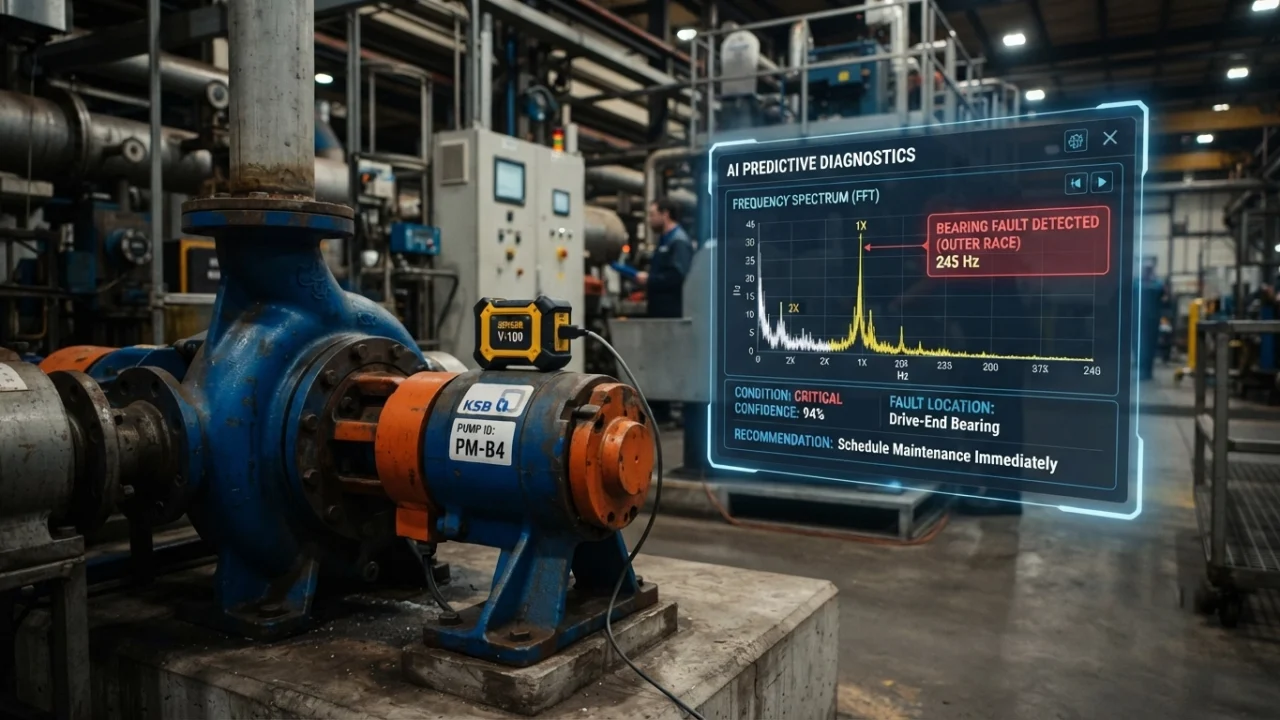
How AI Interprets Vibration Data: From Raw Signals to Maintenance Decisions
Modern industrial facilities generate more machine data than ever before.
Vibration sensors continuously monitor rotating equipment. Industrial IoT devices stream data around the clock. Condition monitoring systems track machine health across entire facilities. Yet despite this explosion of information, equipment failures still occur unexpectedly, production downtime remains costly, and maintenance teams continue to struggle with identifying critical issues before they become operational problems.
Why?
Because collecting machine data and understanding machine data are two very different challenges.
A vibration sensor can tell you that something has changed. It cannot always explain what changed, why it matters, how severe the issue is, or when maintenance intervention is required.
This is the challenge that AI vibration analysis is solving.
By combining machine learning, predictive analytics, reliability engineering, and machine condition monitoring, modern AI systems can transform raw vibration signals into actionable maintenance decisions that support predictive maintenance programs.Instead of simply detecting abnormalities, AI helps maintenance teams identify likely fault types, prioritize risks, and intervene before failures impact operations.
In this article, we’ll explore how AI interprets vibration data, how it differs from traditional monitoring approaches, and, more importantly, why AI-powered predictive maintenance is becoming a cornerstone of modern asset reliability programs.
Every Machine Is Communicating
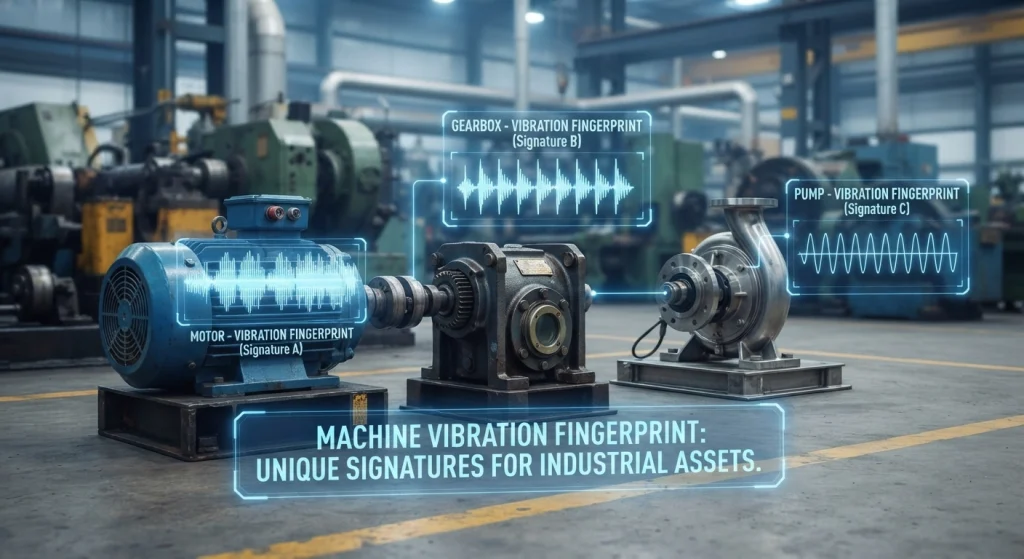
Every rotating machine generates vibration.
Motors, pumps, compressors, fans, gearboxes, turbines, conveyors, and countless other industrial assets produce unique vibration signatures during normal operation.
These signatures act like fingerprints.
When equipment operates normally, vibration patterns remain relatively stable. When faults begin to develop, these patterns change.
Common causes include:
- Bearing degradation
- Shaft misalignment
- Rotor imbalance
- Mechanical looseness
- Gear wear
- Lubrication problems
- Resonance issues
- Cavitation
Long before a machine fails, these conditions typically create measurable changes in vibration behavior.
The challenge is not whether the machine is communicating.
The challenge is understanding what it is saying.
Why Raw Vibration Data Isn’t Enough
Many organizations assume that installing vibration sensors automatically solves reliability problems.
However, data alone does not prevent failures.
Consider a facility operating:
- 300 rotating assets
- 1,000+ vibration sensors
- Multiple production lines
- Continuous monitoring systems
As a result, maintenance teams may accumulate hundreds of thousands of measurements within a single week.
Furthermore, these datasets contain:
- Normal operating conditions
- Process variations
- Environmental influences
- Equipment loading changes
- Sensor noise
- Developing fault signatures

Finding meaningful fault indicators within this volume of information is difficult.
Without effective analysis, organizations often face a paradox:
More data. Less clarity.
As a result, machine condition monitoring programs frequently struggle to deliver their full value.
While collecting signals is relatively easy, extracting meaningful insight remains a significant challenge.
How Human Vibration Analysts Interpret Machine Data
Before understanding how AI works, it’s important to understand how experienced vibration analysts approach diagnostics.
A skilled vibration specialist rarely focuses on a single vibration reading.
Instead, they evaluate:
- Frequency spectra
- Historical trends
- Harmonic patterns
- Operating conditions
- Asset history
- Failure signatures
For example:
A bearing defect produces different vibration characteristics than a shaft misalignment issue.
A gearbox fault creates different spectral patterns than rotor imbalance.
Experienced analysts compare observed patterns against known fault signatures and determine:
- Whether a fault exists
- What type of fault it is
- How severe it is
- How quickly it is progressing
This process is highly effective.
However, it has one major limitation:
Unfortunately, this approach does not scale easily.
A single analyst can only review a finite number of assets each day, whereas large industrial facilities may operate hundreds or even thousands of monitored machines.
Consequently, the gap between available machine data and available vibration expertise continues to expand.
This is where artificial intelligence delivers significant value by helping organizations analyze machine data at scale.
How AI Interprets Vibration Data
Contrary to common misconceptions, industrial AI does not “guess.”
Rather, it recognizes patterns and relationships within machine data.
To achieve this, machine learning models are trained using large datasets containing examples of:
- Healthy machine behavior
- Known fault conditions
- Historical maintenance records
- Failure outcomes
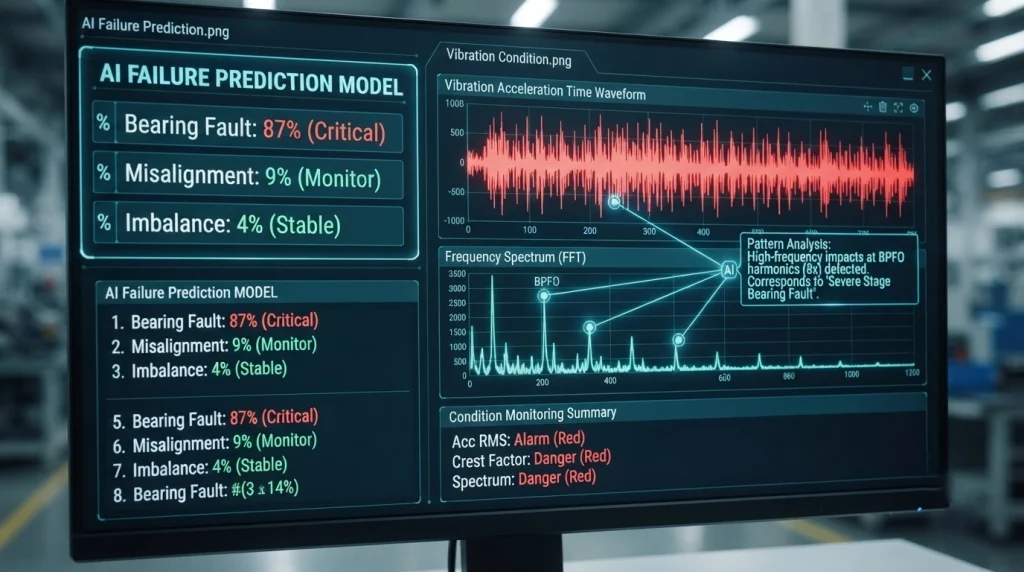
How AI Interprets Vibration Data
The model learns relationships between vibration patterns and equipment conditions.
When new vibration data arrives, AI compares it against previously learned patterns. Instead of simply reporting:
Vibration increased by 12%.
the system evaluates questions such as:
Does this pattern resemble an early-stage bearing defect?
or
Does this behavior match a shaft misalignment signature?
As a result, the focus shifts from raw measurements to actionable insights. Consequently, this represents one of the most significant advancements in reliability engineering over the past decade.
The conversation changes from anomaly detection to fault diagnosis.
How AI Analyzes Frequency Spectra
One of the most powerful aspects of vibration analysis involves understanding frequency content.
Raw vibration signals are initially measured in the time domain. However, many mechanical faults become easier to identify when the data is viewed in the frequency domain.
Therefore, systems use a mathematical process known as:
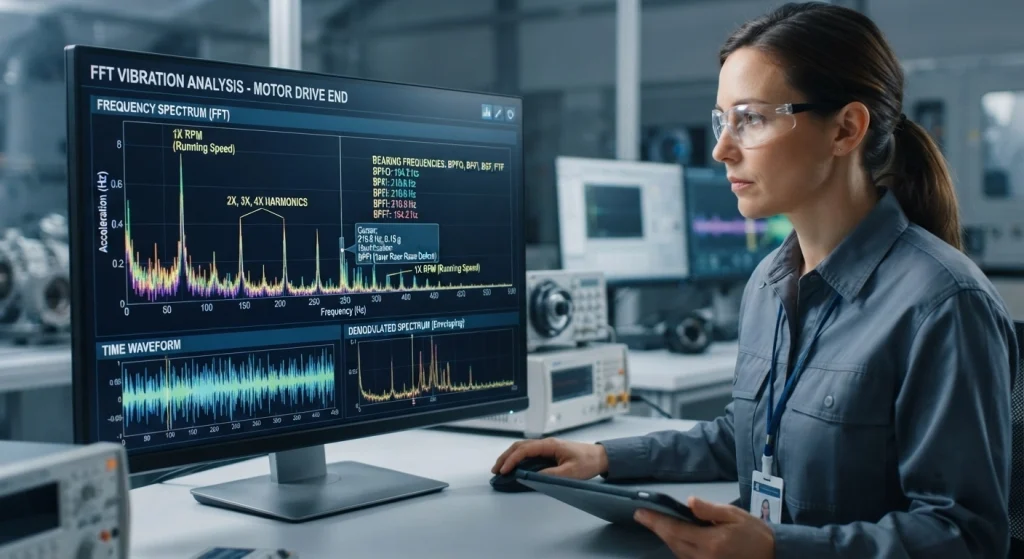
FFast Fourier Transform (FFT)
FFT converts vibration signals into frequency spectra, allowing analysts and AI systems to identify characteristic frequencies associated with specific fault types.
Using this approach, AI evaluates:
- Running speed frequencies
- Harmonics
- Sidebands
- Bearing defect frequencies
- Gear mesh frequencies
- Resonance frequencies
For example, a bearing defect often generates specific high-frequency patterns, while a misalignment issue may produce elevated harmonics. Similarly, gear wear frequently appears around gear mesh frequencies.
As a result, AI can continuously analyze frequency-domain information and identify patterns associated with developing faults. Consequently, organizations no longer need to rely solely on manually reviewing thousands of spectra, significantly improving both speed and consistency.
From Detection to Diagnosis
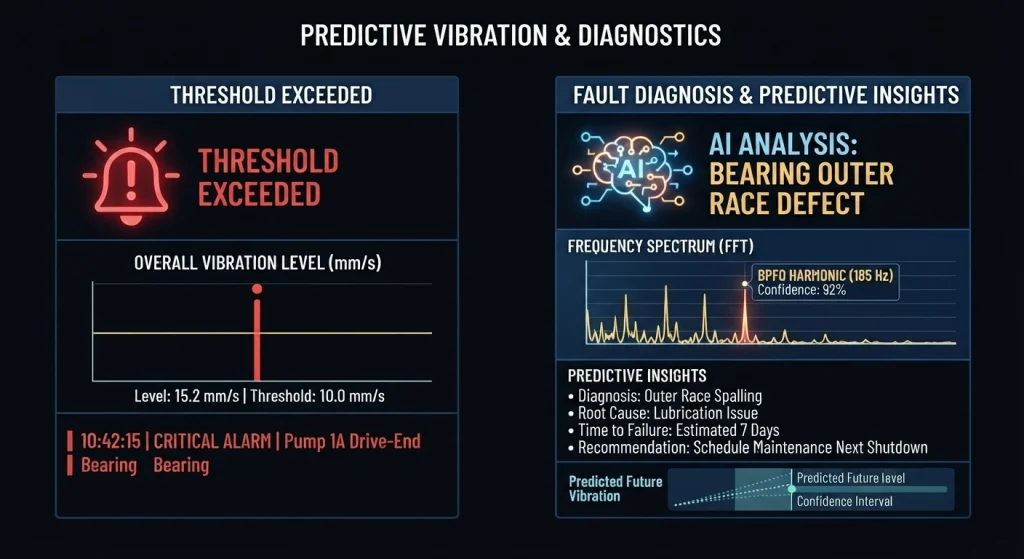
Traditional monitoring systems often rely on thresholds.
If vibration exceeds a predefined limit:
Alarm.
If vibration remains below the limit:
No alarm.
While this approach is simple, it has significant limitations.
Many faults develop gradually, and some of the most valuable warning signs appear weeks before vibration levels exceed alarm thresholds.
However, AI approaches the problem differently.
Instead of asking:
“Has vibration exceeded a limit?”
AI asks:
“Does this pattern resemble a known fault?”
As a result, maintenance teams can identify problems earlier and take corrective action before failures occur, supporting a more proactive predictive maintenance approach.
Common Fault Patterns AI Can Detect
Modern AI vibration analysis platforms can identify a wide range of rotating equipment faults.
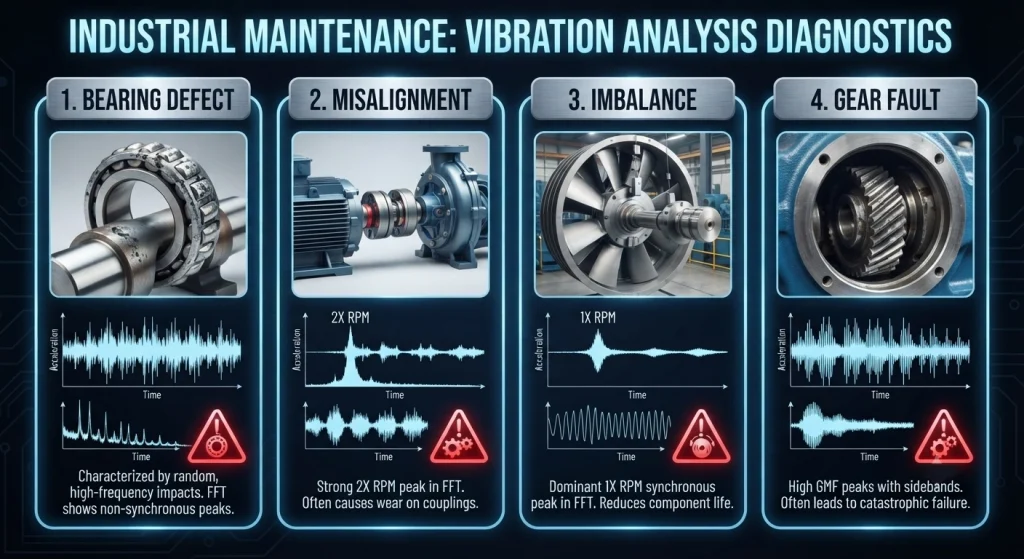
BBearing Defects
Common indicators include:
- High-frequency vibration
- Envelope spectrum anomalies
- Characteristic bearing frequencies
As a result, bearing faults are often among the earliest detectable machine failures.
Shaft Misalignment
Typical indicators include:
- Elevated harmonics
- Axial vibration increases
- Coupling-related frequency patterns
Furthermore, misalignment often accelerates wear across multiple components.
Rotor Imbalance
Common characteristics include:
- Elevated running-speed vibration
- Consistent amplitude increases
- Stable frequency patterns
Consequently, imbalance can increase stress on bearings and support structures.
Mechanical Looseness
AI systems recognize:
- Broadband vibration
- Multiple harmonic frequencies
- Structural instability patterns
In addition, these signatures often indicate developing mechanical or structural issues.
Gear Faults
Indicators include:
- Gear mesh frequency changes
- Sideband development
- Progressive deterioration patterns
For example, developing gear wear frequently appears through changes in gear mesh frequencies and sideband activity.
Cavitation
AI can identify:
- Random vibration bursts
- Broadband frequency activity
- Pump performance anomalies
As a result, maintenance teams can detect cavitation before significant pump damage occurs.
Resonance Issues
Resonance often produces:
- Amplified vibration responses
- Frequency-specific energy increases
- Structural dynamic abnormalities
Therefore, early identification of resonance conditions is essential for protecting equipment and maintaining reliability.
These fault-specific patterns allow AI systems to move beyond simple anomaly detection and provide meaningful diagnostic insight. Consequently, maintenance teams can make faster, more informed decisions based on the likely root cause of a developing issue.
Traditional Monitoring vs AI-Assisted Analysis
| Traditional Monitoring | AI-Assisted Analysis |
| Displays vibration levels | Interprets fault patterns |
| Threshold-based alarms | Pattern-based diagnostics |
| Requires extensive manual review | Automated analysis at scale |
| Focuses on detection | Focuses on diagnosis |
| Difficult to scale | Designed for large asset fleets |
| Reactive approach | Predictive approach |
The difference is not simply automation.
The difference is intelligence.
Not Every Anomaly Matters
One of the biggest concerns surrounding industrial AI is false alarms.
Maintenance teams already receive:
- Alerts
- Notifications
- Threshold violations
- Work requests
An effective AI system should reduce noise rather than create more of it.
Advanced AI models evaluate:
- Fault severity
- Confidence levels
- Asset criticality
- Rate of deterioration
- Historical behavior
This helps prioritize issues based on business impact.
Instead of reviewing hundreds of anomalies, engineers receive a focused list of actionable findings.
CChallenges of AI Vibration Analysis
Although AI provides substantial benefits, successful implementation requires realistic expectations.
Data Quality Matters
Poor-quality sensor data leads to poor-quality diagnostics. Therefore, sensor calibration, installation, and maintenance remain critical.
Sensor Placement Is Important
Incorrect sensor positioning can reduce fault visibility and affect model accuracy. As a result, proper sensor placement is essential for reliable condition monitoring.
Operating Conditions Can Be Complex
Machines operating under variable loads often produce more complicated vibration patterns. Consequently, AI systems must account for changing operating conditions.
False Positives Remain Possible
No diagnostic system is perfect. Therefore, organizations should validate findings and incorporate engineering judgment into maintenance decisions.
Training Data Influences Accuracy
AI systems are only as strong as the data used to train them.
Models trained on diverse industrial datasets generally perform better across different equipment types and operating environments.
Scaling Expertise Across Entire Facilities
Perhaps the greatest advantage of AI is its ability to scale expertise.
Most facilities cannot employ enough vibration specialists to continuously review every monitored asset. As a result, reliability teams often face growing volumes of machine data with limited analytical resources.
Fortunately, AI helps apply consistent analysis across:
- Multiple facilities
- Hundreds of machines
- Thousands of sensors
- Millions of measurements
This allows engineering expertise to focus on decision-making rather than data screening.
For organizations facing skilled labor shortages, this capability has become increasingly valuable.
The Business Impact of AI-Powered Predictive Maintenance
The value of AI vibration analysis extends beyond technical diagnostics.
Consequently, organizations implementing predictive maintenance and condition-based maintenance strategies often experience:
- Reduced maintenance costs
- Lower unplanned downtime
- Improved asset availability
- Extended equipment life
- Better resource utilization
- Increased production reliability
Research from McKinsey & Company has shown that digitally enabled reliability programs can significantly improve asset performance while reducing maintenance expenses.
The benefits are both operational and financial.
The Future of AI in Predictive Maintenance
The next generation of industrial reliability is already emerging.
As a result, several technologies are accelerating the evolution of AI-powered maintenance.
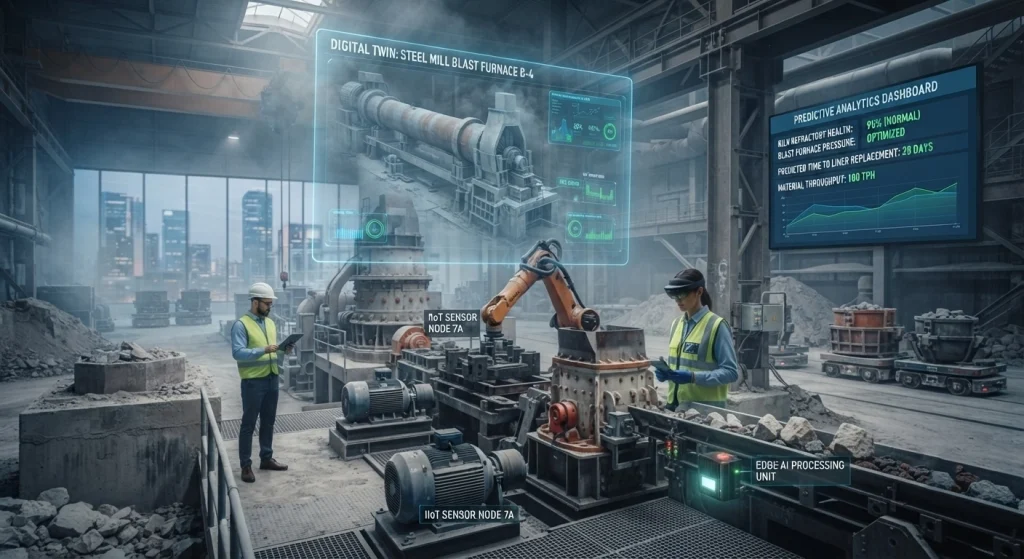
EEdge AI
Models run directly on monitoring hardware, enabling real-time diagnostics without cloud latency. As a result, organizations can respond to developing issues more quickly.
Industrial IoT
Connected sensors provide continuous visibility into equipment health across entire operations. Furthermore, they enable more comprehensive condition monitoring at scale.
Digital Twins
Virtual representations of physical assets allow organizations to simulate performance and predict failures. Consequently, maintenance teams can make more informed planning decisions.
Predictive Analytics
Advanced models estimate remaining useful life and forecast maintenance requirements. This helps organizations optimize maintenance schedules and reduce unexpected failures.
Autonomous Reliability Programs
Future systems will increasingly recommend corrective actions automatically based on real-time machine behavior.
However, the goal is not fully autonomous maintenance.
Instead, the goal is smarter, faster, and more informed decision-making.
Human Expertise Still Matters
AI is not a replacement for reliability engineers, maintenance planners, or vibration analysts.
Rather, it acts as a force multiplier.
AI identifies patterns, while engineers apply expertise and maintenance teams implement corrective actions.
Consequently, the most successful reliability programs combine technology, engineering judgment, and operational execution.
Organizations that understand this balance achieve the greatest value from industrial AI initiatives.
Frequently Asked Questions
No. AI helps scale diagnostics and identify patterns, but human expertise remains essential for validation, planning, and maintenance decisions.
To begin with, machine learning models are trained on historical vibration data containing examples of known machine conditions and failure modes. As a result, these models can recognize patterns and identify potential equipment faults more effectively.
Yes. Many AI systems can identify bearing defect patterns associated with inner race, outer race, cage, and rolling element failures. As a result, maintenance teams can detect developing faults long before a functional failure occurs.
Yes. Pattern-based analysis often detects developing faults weeks before traditional threshold alarms activate.
Manufacturing, mining, steel, cement, oil and gas, power generation, utilities, food processing, and chemical production all benefit significantly.
Historical data improves accuracy, although modern systems can also leverage broader industrial datasets.
Traditional monitoring focuses primarily on detecting abnormal vibration levels. In contrast, AI interprets vibration patterns, identifies likely fault types, and helps prioritize maintenance actions.
Yes. Organizations using predictive maintenance, machine condition monitoring, and reliability analytics frequently report lower maintenance costs and reduced downtime.
As a result, they can improve asset reliability, optimize maintenance resources, and increase overall operational efficiency.
Conclusion
Industrial organizations no longer suffer from a lack of machine data.
They suffer from a lack of machine insight.
As monitoring programs continue to expand, the volume of vibration information generated by industrial assets will only increase. The organizations that succeed will be those capable of transforming raw signals into meaningful decisions faster than ever before.
AI vibration analysis bridges the gap between data collection and maintenance action.
By combining machine learning, predictive analytics, reliability engineering, and condition-based maintenance, AI helps organizations identify developing faults earlier, prioritize resources more effectively, and improve overall asset reliability.
Because vibration data alone does not prevent failures.
Actionable maintenance intelligence does.