Unbalance vs Misalignment: Why These Two Faults Look Similar but Aren’t
Two Faults, One Problem: Unbalance vs Misalignment in Vibration Analysis
In rotating equipment diagnostics, unbalance vs misalignment is one of the most commonly misunderstood comparisons in predictive maintenance.
Both conditions often show up as increased vibration, unstable trends, and alarm triggers that cross the ISO 20816-3 severity zones for industrial machinery. As a result, maintenance teams sometimes treat them as interchangeable problems.
But in reality, they are fundamentally different mechanical issues.
And misdiagnosing them leads to one of the most expensive problems in maintenance engineering:
Fixing the wrong root cause while the real fault continues to damage the asset.
Understanding the difference between these two vibration analysis faults is not theoretical. It directly affects equipment reliability, maintenance cost, and downtime reduction strategies, starting with reliable early fault detection.
Why Unbalance vs Misalignment Gets Confused
The confusion usually starts at the monitoring system level.
Most vibration dashboards initially show:
- Increased amplitude
- Higher running-speed vibration
- Alarm threshold crossings
At this stage, systems often label both conditions simply as “anomaly.”
The problem is that magnitude alone doesn’t define vibration.
Instead, several factors define it:
- Frequency content
- Harmonic structure
- Phase behavior
- Direction of vibration (axial vs radial)
- Trend evolution over time
Without analyzing these deeper patterns, unbalance and misalignment can look nearly identical in early detection stages.
What Is Unbalance? A Common Rotating Equipment Diagnosis Challenge
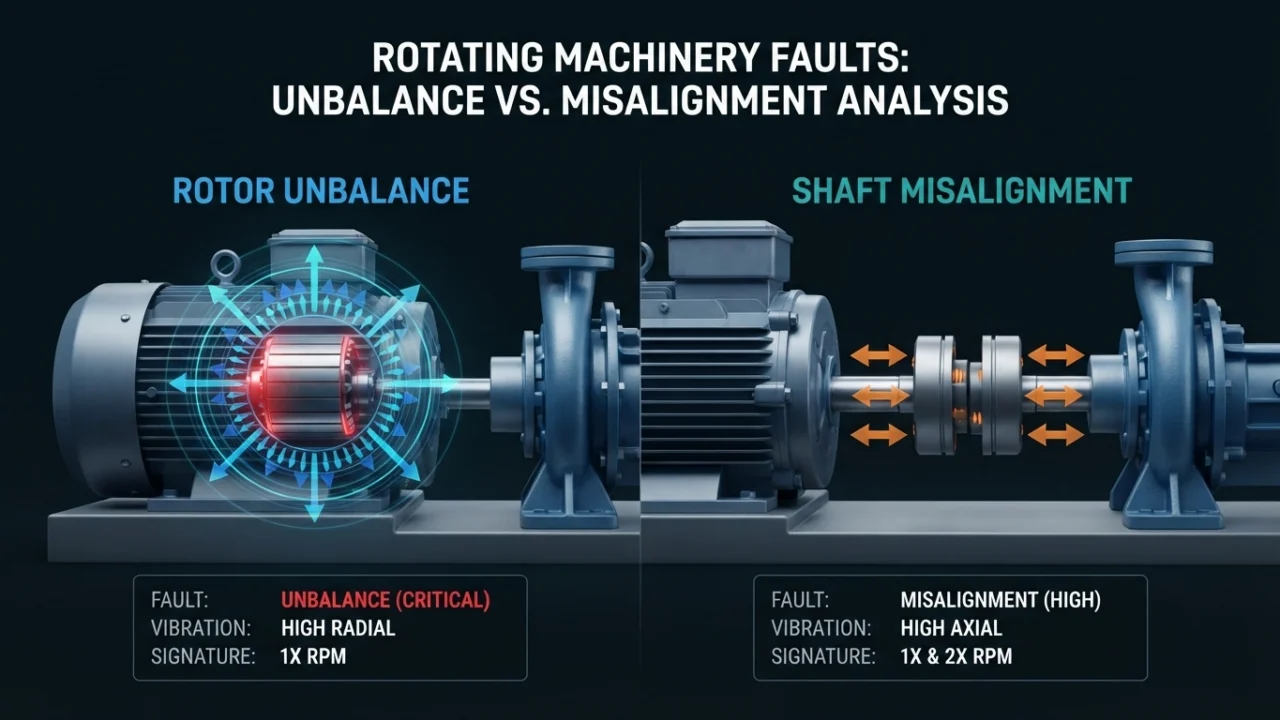
Unbalance occurs when mass sits unevenly around a rotating shaft.
As the machine rotates, centrifugal force pulls the heavier side outward, creating a consistent vibration signature.
Key characteristics of unbalance:
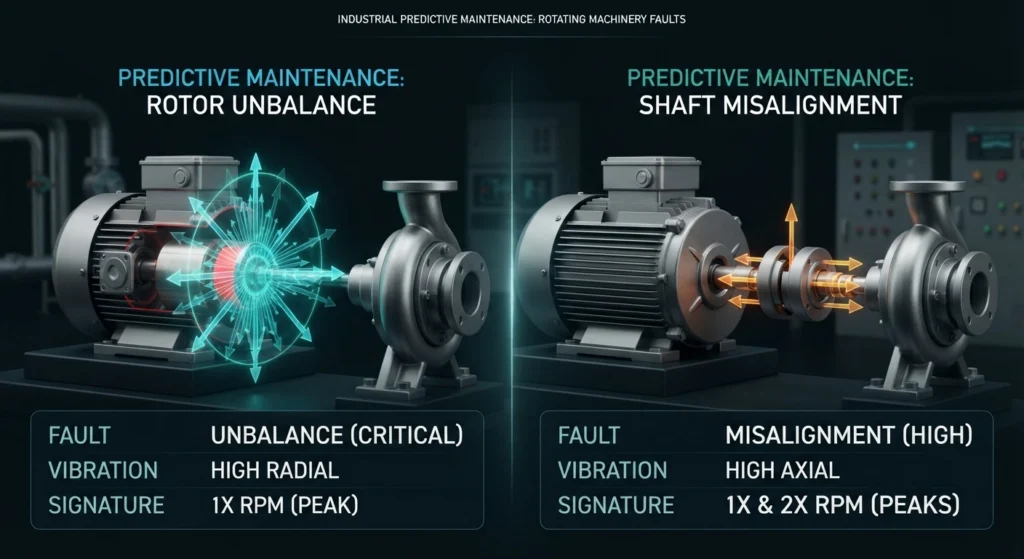
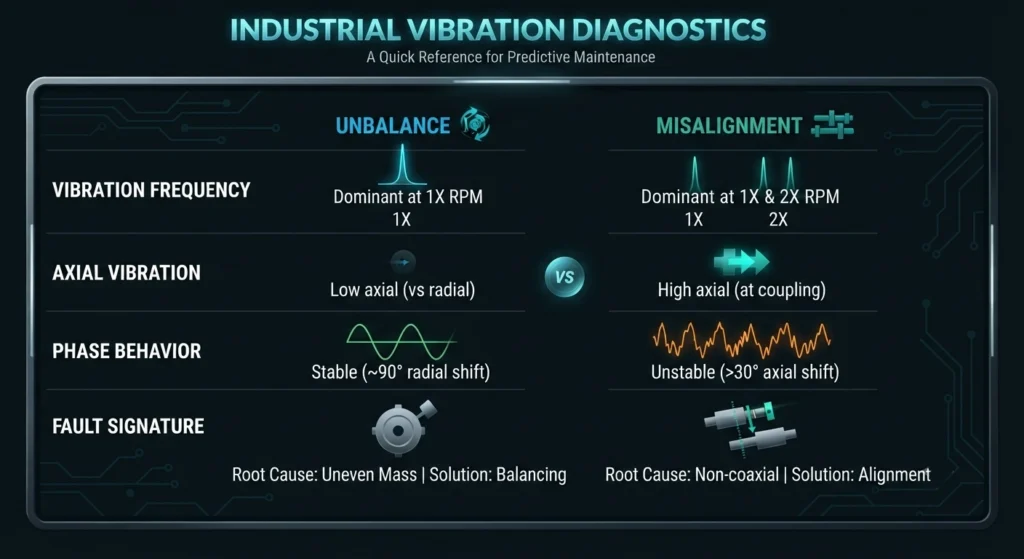
- Dominant vibration at 1× running speed (RPM)
- Stable phase angle over time
- Vibration increases with speed
- Strong radial vibration
- Smooth sinusoidal waveform
In simple terms:
The rotor behaves like it has a “heavy spot” that rotates continuously.
This creates a predictable and relatively stable vibration pattern.
What Is Misalignment? Another Key Vibration Analysis Fault
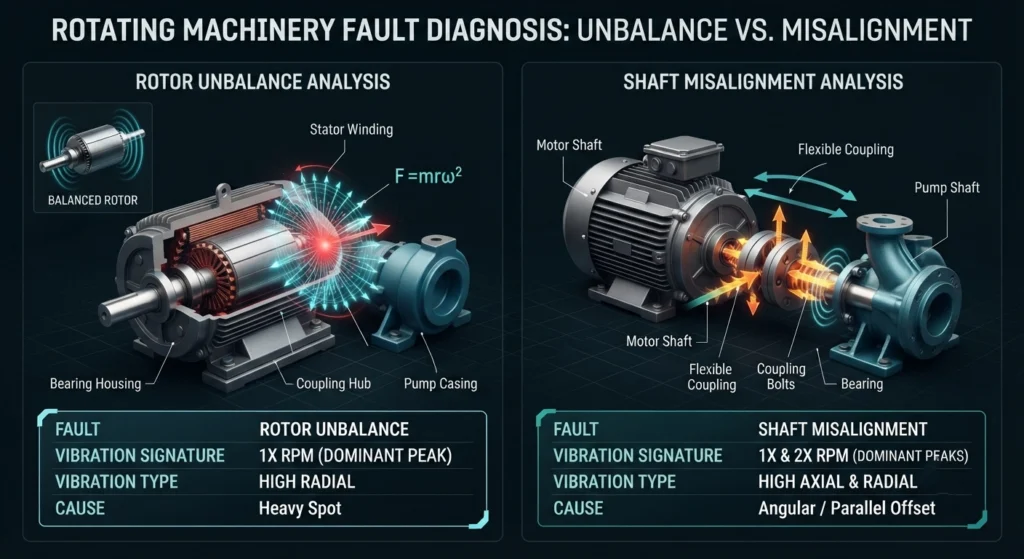
Misalignment occurs when two connected shafts don’t share a properly aligned axis.
This creates mechanical stress at the coupling and forces the system to operate under continuous geometric distortion.
Key characteristics of misalignment:
- Strong vibration at 1× and 2× RPM
- Often includes higher harmonics (3× and above)
- Elevated axial vibration
- Unstable phase behavior under load changes
- Increased coupling stress
In simple terms:
The machine is being forced to rotate in a mechanically “strained position.”
This creates more complex vibration behavior than unbalance.
Unbalance vs Misalignment: Technical Comparison
| Feature | Unbalance | Misalignment |
| Primary frequency | 1× RPM | 1× and 2× RPM |
| Harmonics | Minimal | Multiple harmonics |
| Axial vibration | Low | High |
| Phase stability | Stable | Unstable |
| Root cause | Mass distribution | Shaft geometry |
| Force type | Centrifugal | Mechanical constraint |
| Damage progression | Gradual | Accelerated wear |
| Maintenance impact | Usually simple correction | Multi-component damage risk |
This difference is critical in rotating equipment diagnosis because corrective actions depend entirely on correct fault identification.
Why Misdiagnosing Unbalance vs Misalignment Is So Expensive
Confusing unbalance with misalignment (or vice versa) leads to incorrect maintenance decisions.
If technicians mistake misalignment for unbalance, they:
- Perform balancing unnecessarily
- Leave the root cause unresolved
- Allow bearings and couplings to keep degrading
If unbalance is mistaken for misalignment:
- Shaft realignment is performed unnecessarily
- Time and labor are wasted
- Vibration issue persists
In both cases, the result is the same:
“In both cases, the result is ultimately the same: the machine continues to degrade while maintenance resources are misused.
This is why an accurate, well-structured predictive maintenance strategy is essential.
How Vibration Analysis Separates Unbalance from Misalignment
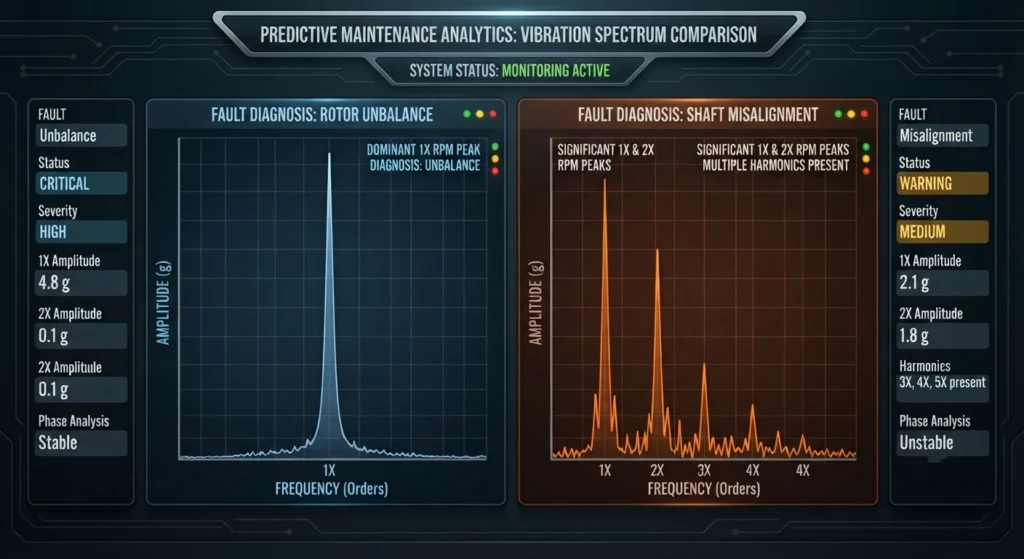
Modern vibration analysis does not rely on single-point thresholds.
Instead, it evaluates:
- Frequency spectrum structure
- Harmonic relationships
- Phase shift behavior
- Axial vs radial vibration distribution
- Trend evolution under different loads
These combined features allow reliable separation between faults that look similar in basic monitoring systems.
Where AI Improves Machine Fault Detection Accuracy
In traditional systems, classification depends heavily on the experience and training of certified vibration analysts. As a result, at scale, this creates inconsistency.
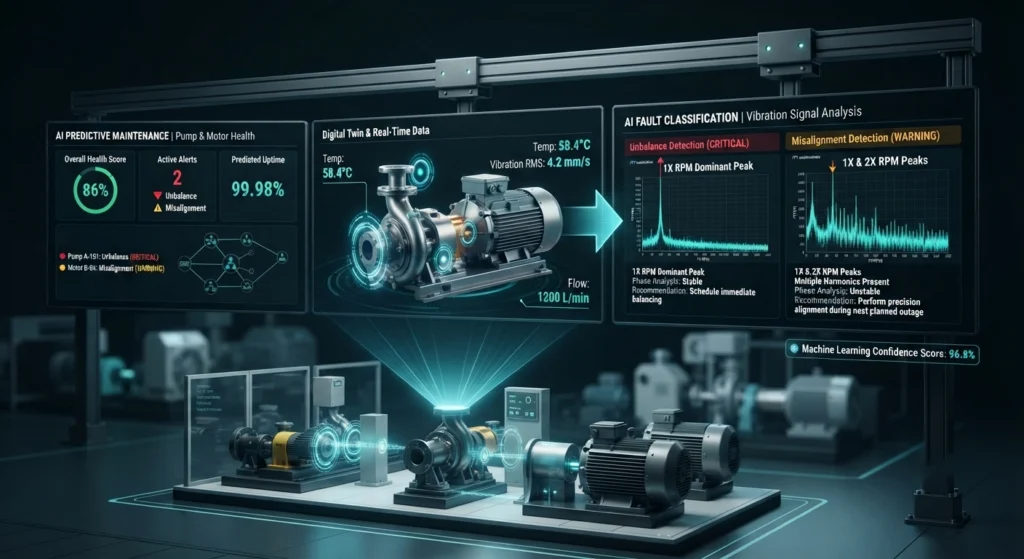
AI-based machine fault detection builds on how AI interprets vibration signals, improving this by:
- Learning known vibration signatures
- Comparing patterns across historical fault data
- Detecting combined faults (very common in real machines)
- Updating diagnosis confidence over time
For example, in real operations, a pump shows:
- High 1× RPM vibration
- Elevated 2× component
- Increased axial vibration
In this case, traditional systems may trigger only a generic alarm. However, AI systems can go further and identify the likely root cause: misalignment with a secondary imbalance contribution. Consequently, this prevents unnecessary balancing interventions and improves maintenance accuracy.
Real Industrial Reality: Condition MoReal Industrial Reality: Condition Monitoring Faults Are Rarely Isolated
In real plants, machines rarely suffer from a single fault. Instead, common combinations include:
- Misalignment → accelerates bearing wear
- Unbalance → amplifies structural looseness
- Looseness → worsens misalignment effects
Together, these interactions create cascading degradation patterns. This is precisely why modern condition monitoring must focus on diagnosis, not just detection.
The Role of AI in Predictive Maintenance
AI does not replace vibration analysts.
Instead, it enhances them by:
- Filtering noise from large datasets
- Prioritizing critical faults
- Identifying early-stage degradation
- Scaling expertise across asset fleets
This is especially important in large industrial environments where thousands of machines generate continuous vibration data.
Business Impact of Correct Rotating Equipment Diagnosis
Correctly distinguishing between unbalance vs misalignment leads to:
- Lower maintenance costs
- Reduced downtime
- Fewer repeat repairs
- Improved asset lifespan
- Better maintenance planning
- Higher reliability performance
This is why industries such as manufacturing, oil & gas, mining, cement, and power generation heavily invest in vibration-based predictive maintenance systems.
Frequently Asked Questions
Because both faults increase vibration amplitude, especially in early stages where harmonic patterns are not clearly visible.
Yes. Combined faults are common and often amplify total vibration severity.
Misalignment is generally more damaging long-term because it introduces continuous mechanical stress across multiple components.
Yes. When frequency, phase, and directional vibration data are analyzed together, accurate classification is possible.
Elevated axial vibration combined with 1× and 2× harmonic components.
Final Takeaway: Unbalance vs Misalignment Explained
The difference between unbalance vs misalignment is not just a technical detail. Rather, it is a decision-making factor in predictive maintenance.
On one hand, unbalance represents a mass distribution problem. On the other hand, misalignment represents a geometric constraint problem. Therefore, treating them as the same leads to incorrect maintenance actions, wasted resources, and continued equipment degradation.
Ultimately, in vibration analysis, the real value is not detecting vibration — it is understanding what is causing it.
Related Article
Bearing Fault Progression: How Small Defects Become Major Failures
Discover how bearing defects develop over time, the warning signs vibration analysis can detect, and how predictive maintenance helps prevent costly equipment failures.