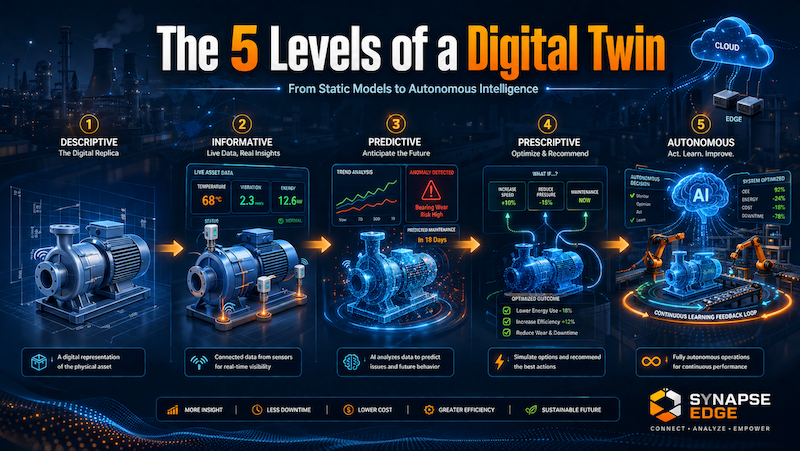
The 5 Levels of a Digital Twin, Explained in Plain English
“Digital twin” has become one of the most misused terms in industry.
It gets attached to 3D models, dashboards, monitoring platforms, BIM files and asset registers — often by people who genuinely believe that’s what the term means. The result is that two people can sit in the same meeting, both say “digital twin,” and be describing completely different things with a decimal point between their price tags.
Most of that confusion clears up the moment you realise a digital twin isn’t one thing you either have or don’t have. It’s a ladder with five rungs. Each rung does something the one below it cannot, and each costs meaningfully more to reach.
Here’s the whole model in plain English, with no jargon and no vendor spin.
Level 0: not actually a twin
A 3D model with live gauges attached to it. It looks superb in a demo. Data streams in, dials move, and everyone in the room nods.
But it only displays. It doesn’t interpret anything, it doesn’t know what “normal” looks like for that asset, and it can’t tell you anything you couldn’t work out by walking the plant with a clipboard. This is a dashboard with a 3D background, and a surprising amount of what gets sold as a digital twin lives here.
It isn’t on the ladder at all. That matters, because a great many organisations think they’re at Level 3 when they’re actually at Level 0.
Level 1: Descriptive — it shows
The first real rung. A live mirror of the physical asset: what its temperature is, how fast it’s running, how much it’s vibrating, right now.
The difference between this and Level 0 is context. A descriptive twin knows the asset’s structure and its normal operating envelope, so “42°C” means something — it’s not just a number on a screen.
What it answers: What is happening?
This is genuinely useful and it is where most working twins sit today. It’s also where a lot of programmes quietly stop, because visibility feels like success.
Level 2: Diagnostic — it explains
Now the twin doesn’t just report the symptom, it finds the cause. Vibration is up on pump 4 — and the twin correlates it with bearing temperature, recent load changes and the last maintenance record to tell you it’s a bearing wear signature, not an alignment issue.
What it answers: Why did it happen?
The jump from Level 1 to Level 2 is mostly a data and context jump rather than an AI one. You need history, you need the asset’s relationships mapped, and you need enough data quality that the correlation means something. It’s a smaller leap than most people expect, and often the best-value one available.
Level 3: Predictive — it forecasts
The twin stops looking backwards and starts looking forwards. Using the asset’s history and behaviour, it forecasts what will happen — flagging a failure weeks before it occurs, or projecting when a component will cross its wear threshold.
What it answers: What is going to happen?
This is the level everyone wants, and the level most budgets are written for. It’s also where the technical difficulty steps up sharply: you need enough historical failure data to learn from, models that stay calibrated as the asset changes, and confidence intervals honest enough that operators trust the warnings instead of ignoring them.
A predictive twin that cries wolf gets switched off within months. Trust is part of the engineering here, not an afterthought.
Level 4: Prescriptive — it advises
Prediction tells you a bearing will fail in three weeks. Prescription tells you what to do about it — and what each option costs.
Run to failure and accept the downtime. Intervene at the next planned shutdown. Reduce load now and stretch the window to six weeks. A prescriptive twin simulates those scenarios against your actual constraints and ranks them.
What it answers: What should we do?
This is where a twin stops being a monitoring tool and starts being a decision-support system. It requires simulation capability on top of prediction, plus enough operational and commercial context that its recommendations are realistic rather than theoretical.
Level 5: Autonomous — it acts
The twin closes the loop. Within limits you define, it acts on its own — adjusting a setpoint, raising a work order, rescheduling a maintenance window, coordinating across multiple assets to protect overall output.
What it does: It decides, and then it does it.
Very few organisations are here, and the barrier is rarely the algorithm. Autonomy is a trust, safety and governance problem before it’s a technical one. You need guardrails, audit trails, clear accountability for what the system does, and an organisation willing to let software act. Most programmes that stall between Level 3 and Level 5 stall for exactly those reasons.
The whole model in five words
Shows → Explains → Forecasts → Advises → Acts.
That’s it. If you remember nothing else, remember that sequence — it’s enough to cut through almost any vendor conversation. Ask which of those five verbs their product actually does, and the picture usually gets clear very quickly.
Why knowing your level matters
Here’s the pattern behind a lot of disappointing twin programmes: the business case is written for Level 4, the budget is approved for Level 3, and what actually gets delivered and lived with is Level 1. Nobody lied at any point. The levels were simply never named, so nobody noticed the gap until year two.
Being explicit about the level does three useful things:
- It makes the business case honest. “We want predictive maintenance on our critical rotating assets” is a scope. “We want a digital twin” is not.
- It exposes the real bottleneck. Each level has its own prerequisite — Level 2 needs history and context, Level 3 needs failure data and calibration, Level 5 needs governance. Naming the level tells you what to fix.
- It stops you overbuying. A Level 2 twin that people trust and use daily delivers more value than a Level 4 twin that’s half-built and ignored. Higher is not automatically better.
That last point is worth sitting with. The goal is not to climb to Level 5. It’s to reach the level that changes the decision you actually care about — and to reach it properly.
Which level do you need?
Start from the decision, not the technology. Pick the single decision you want to improve, then work out the lowest level that would genuinely change it.
If you want to stop being surprised by failures, you need Level 3. If you just need to stop arguing about why something broke, Level 2 will do it — at a fraction of the cost. If your maintenance planning is the bottleneck rather than your detection, Level 4 is where the value is.
The mistake is choosing a level because it sounds impressive, then discovering the foundations underneath it don’t hold. Every level depends entirely on the one below: prediction built on data nobody trusts is just a confident guess.
That foundation question is worth answering before you commit to anything. We’ve written about it separately in the Digital Twin Readiness Scorecard, and built a free interactive maturity assessment that scores your twin across data, model, AI, action and governance in about two minutes.
Where SynapseEdge fits
We help asset-heavy organisations work out which level they need, and then actually get there — from LPWAN sensors in the field through to twins that change decisions.
- Hands-on workshops — for teams building the capability in-house. Over two days you’ll stand up a working sensor-to-twin pipeline and understand every layer of it.
- Consultancy — for teams who want it done with them, drawing on real deployments across critical infrastructure, energy and manufacturing.
Book a 20-minute readiness call and we’ll tell you honestly which level you’re at, and which one is worth aiming for.
Which level is your twin at today? It’s a more uncomfortable question than it sounds — and a more useful one than almost any technology decision you’ll make this year.